Strength Training on GLP-1s: How to Protect Your Muscle
Why weight loss can include fat-free mass, and how resistance training and protein may help protect strength.

If you’re considering compounded semaglutide or compounded tirzepatide for weight management, you may have wondered: Will I lose muscle as I lose weight? And should strength training be part of my routine?
They’re reasonable questions.
Weight loss can involve reductions in both body fat and fat-free mass—not body fat alone. That can happen with diet-induced weight loss as well as medication-assisted weight loss. This is why it can be helpful to look beyond the number on the scale and consider strength, nutrition, physical activity, and overall body composition along the way.
Resistance training is one of the better-supported strategies for helping preserve fat-free mass and muscular strength during weight loss. However, research specifically studying resistance training in people using compounded semaglutide or compounded tirzepatide is limited. Much of what we know about resistance training comes from weight-loss research more broadly.
About compounded medications: Compounded semaglutide and compounded tirzepatide are not FDA-approved. FDA does not review compounded drugs for safety, effectiveness, or quality before they are marketed. Research involving FDA-approved semaglutide or tirzepatide products should not be assumed to produce the same results with a compounded formulation.
Does Weight Loss Mean Losing Muscle?
Not necessarily—but some loss of fat-free mass can occur during weight loss.
When the body loses weight, that weight may come from both fat mass and non-fat tissue. This is not unique to medication-assisted weight loss. Studies of calorie-restricted diets have also found reductions in fat-free mass.
There is an important distinction, though:
Lean Mass Is Not the Same as Skeletal Muscle
The terms lean mass and fat-free mass include more than skeletal muscle.
Depending on how body composition is measured, they can include:
- skeletal muscle
- body water
- organs
- connective tissue
- bone and other non-fat tissues
So when a study reports a reduction in lean or fat-free mass, it does not mean that all of that change represents lost skeletal muscle.
That distinction is important when reading headlines about “muscle loss” during weight loss.
What Do We Know About Semaglutide and Tirzepatide?
Semaglutide and tirzepatide are different medications that affect pathways involved in appetite and food intake.
Semaglutide
Semaglutide is a GLP-1 receptor agonist. GLP-1 is involved in regulating appetite and calorie intake.
FDA-approved semaglutide products used for weight management have been shown to reduce calorie intake, with effects believed to be mediated in part through appetite. Semaglutide also delays gastric emptying.
FDA labeling for approved semaglutide weight-management products includes reduced-calorie nutrition and increased physical activity as part of treatment.
Tirzepatide
Tirzepatide is a GIP and GLP-1 receptor agonist, meaning it acts on two receptor pathways involved in appetite and food-intake regulation.
Why Strength Training Matters During Weight Loss
Strength training may not make the number on the scale drop faster—and that isn’t necessarily the goal.
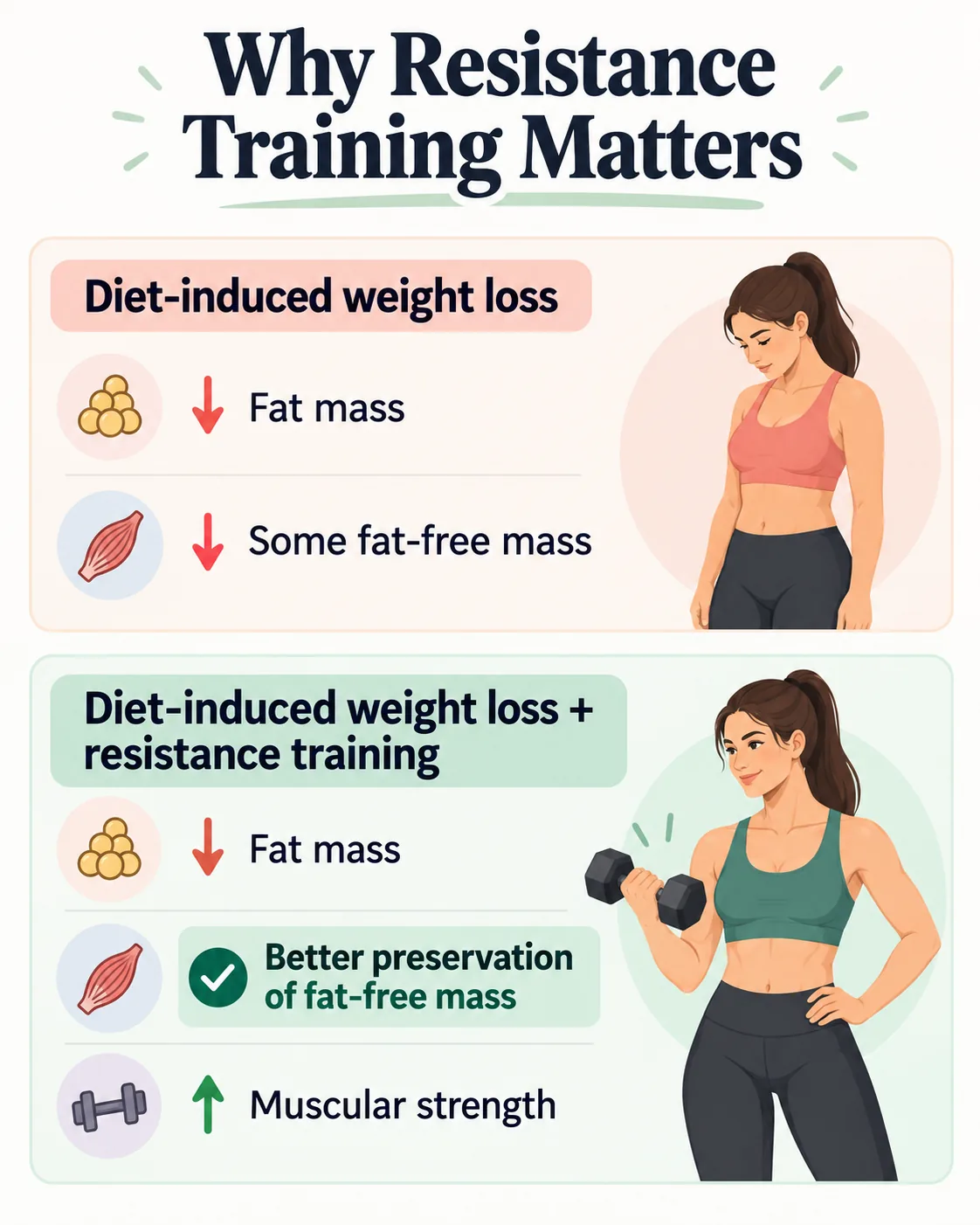
Research in adults with overweight or obesity undergoing dietary weight loss has found that adding resistance exercise can help:
- reduce the loss of fat-free mass
- support greater loss of fat mass
- improve muscular strength
A 2025 systematic review and meta-analysis of 25 randomized controlled trials found that adding resistance exercise to dietary weight loss did not significantly increase total weight loss compared with diet alone. It did, however, help preserve fat-free mass and improve strength.
That means two people could lose a similar amount of weight while experiencing different changes in body composition.
Protect More Than Just the Number on the Scale
The scale tells you how much you weigh. It does not tell you what that weight is made of.
During a weight-loss journey, it can be useful to think about:
Resistance training can be one piece of that bigger picture.
Exercising While Using Compounded Semaglutide or Compounded Tirzepatide
There is no FDA-established “best time” to strength train around a compounded semaglutide or compounded tirzepatide dose.
How you feel can also vary throughout treatment.
FDA has received reports of gastrointestinal symptoms associated with compounded semaglutide and compounded tirzepatide, including nausea, vomiting, diarrhea, abdominal pain, and constipation. FDA has also reported dosing-related adverse events with some compounded GLP-1 products.
If symptoms are making it difficult to exercise, eat, drink enough fluids, or complete your normal activities, talk with your healthcare professional rather than changing your dose or dosing schedule on your own.
Your healthcare professional can help determine whether your exercise plan is appropriate based on your health history, medications, symptoms, and current fitness level.
How Often Should You Strength Train?
For adults generally, federal physical-activity guidelines recommend muscle-strengthening activities involving all major muscle groups on at least two days each week.
That can include:
- free weights
- weight machines
- resistance bands
- body-weight exercises
- other activities that make your muscles work harder than usual
This is a general physical-activity recommendation—not a special exercise prescription for people using semaglutide or tirzepatide.
If you are new to resistance training, starting gradually can make the routine easier to maintain. People with injuries, mobility limitations, cardiovascular conditions, or other medical concerns should discuss an appropriate exercise plan with a healthcare professional.
What About Protein?
Protein is important for maintaining and repairing body tissues, including skeletal muscle.
During weight loss, getting enough nutrition can be especially important because eating less overall may make it harder to meet some nutritional needs.
Research suggests that adequate protein intake, particularly when combined with resistance exercise, may help support the preservation of lean tissue during weight loss.
However, there is no single FDA-approved protein target for people using semaglutide or tirzepatide.
Protein needs can vary based on factors such as:
- age
- body size
- activity level
- overall diet
- medical conditions
- kidney function
A healthcare professional or registered dietitian can help determine an appropriate amount for your individual needs.
The Bottom Line
Weight loss can involve changes in both fat mass and fat-free mass, whether weight is lost through nutrition changes, medication-assisted treatment, or a combination of approaches.
That does not mean that every reduction in “lean mass” represents skeletal-muscle loss.
Resistance training has good evidence for helping preserve fat-free mass and improve muscular strength during dietary weight loss. Research specifically examining resistance training in people using compounded semaglutide or compounded tirzepatide remains limited, so results from studies of other weight-loss approaches or FDA-approved products should not automatically be applied to compounded medications.
The goal of weight management does not have to be simply making the number on the scale as small as possible.
Strength, nutrition, physical activity, body composition, and overall health matter too.
Frequently Asked Questions
Can I Strength Train While Using Compounded Semaglutide or Compounded Tirzepatide?
Strength training can be part of a healthy physical-activity routine for many adults. However, what is appropriate for you depends on your health, fitness level, other medications, and how you are responding to treatment.
Talk with your healthcare professional if you have concerns about starting or changing your exercise routine.
Is There a Best Time to Strength Train Around My Dose?
There is currently no FDA-established best time to exercise in relation to a compounded semaglutide or compounded tirzepatide dose.
Some people may adjust their exercise schedule based on how they feel, but medication or dosing changes should be discussed with the prescribing healthcare professional.
How Many Days a Week Should I Strength Train?
Federal physical-activity guidelines recommend muscle-strengthening activities involving the major muscle groups on at least two days per week for adults.
This recommendation applies to adults generally and is not specific to semaglutide or tirzepatide treatment.
Should I Eat More Protein While Using Compounded Semaglutide or Compounded Tirzepatide?
Protein is an important part of maintaining and repairing muscle tissue, but there is no single protein target that is right for everyone.
Your needs depend on your age, body size, diet, activity level, health conditions, and other factors. If you are concerned about meeting your protein or nutritional needs while losing weight, consider speaking with your healthcare professional or a registered dietitian.